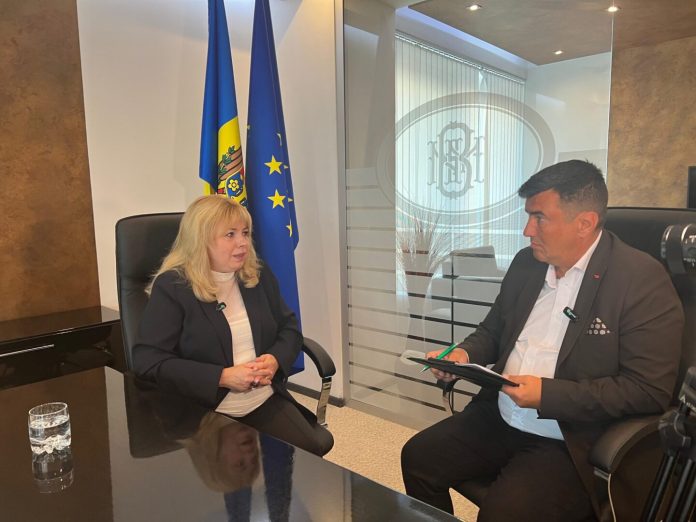
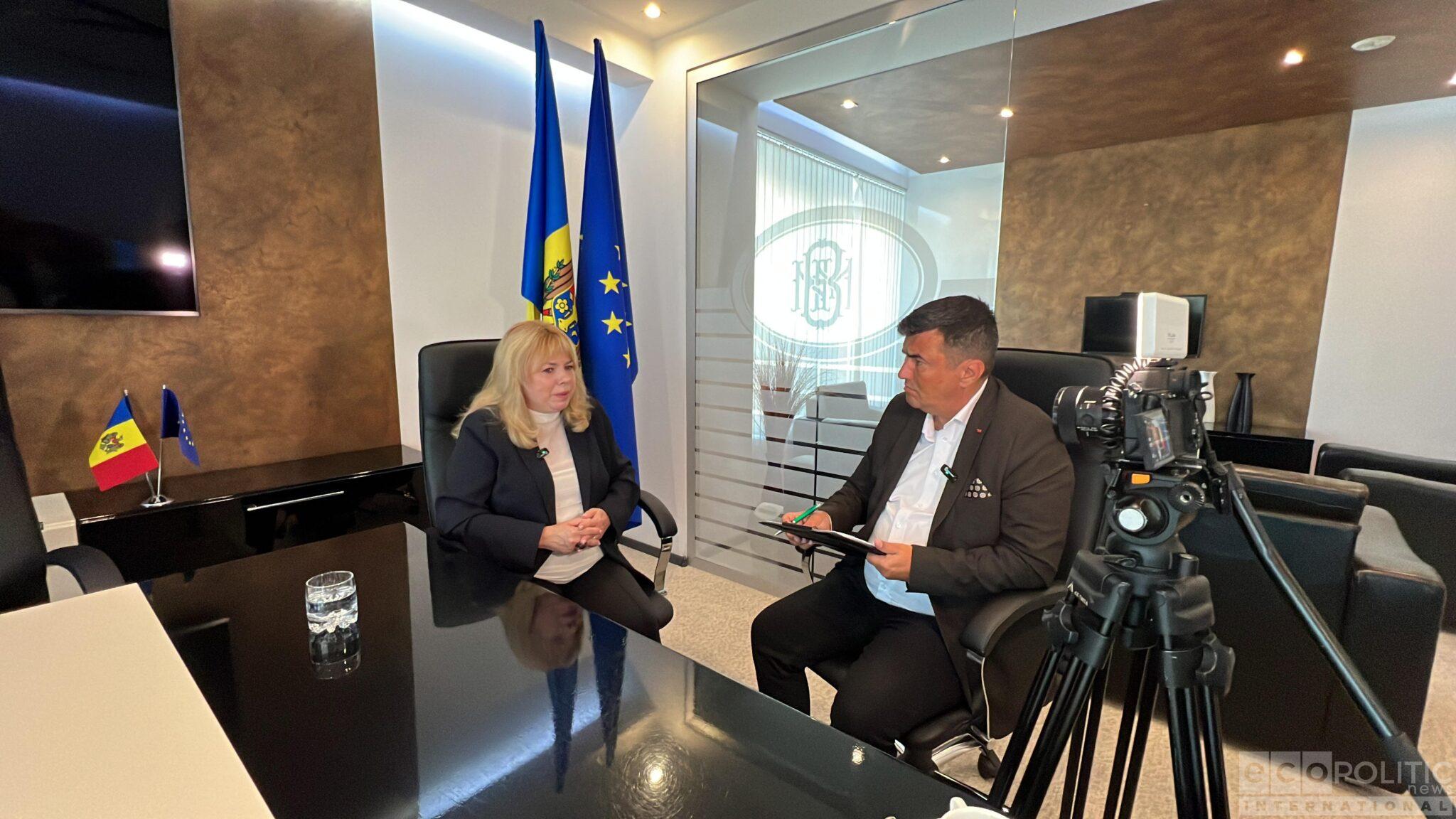
In an interview with ecopolitic.ro, Anca Dragu, Governor of the National Bank of Moldova (BNM), spoke about the exchange of experience and best practices between Romania and the Republic of Moldova in the financial and banking sector and beyond.
Dragu pointed out that the National Bank of Romania (BNR) helped the Republic of Moldova join the SENA (Single Euro Payments Area).
Anca Dragu: Forget SEPA, we just discussed this and, as I said, SEPA meant a file of about 1,000 pages from the National Bank of Romania. There was a dedicated person who worked and guided us on this path, how the file should look, what to put in it, but this support came as part of a support program led by the European Union, in which the National Bank of Romania, together with the Bank of Lithuania and the Bank of the Netherlands, was a part. SEPA was strictly in the hands of the NBR.
Reporter: Thank you for welcoming us in your new capacity, that is, new in the sense that you hold a fairly important position in the Republic of Moldova, as head of the National Bank of Moldova, former minister, former second-in-command in Romania, and now in the Republic of Moldova.
Anca Dragu: Hello, welcome to the National Bank of Moldova. I am glad to see you in this context and yes, it is a very important role, first of all in view of the stage the country is at, namely the process of accession to the European Union. That is why people in positions of authority and state institutions are relevant at this moment in the country’s history.
Reporter: That is precisely where I would like to start. For example, from your point of view, what role does the institution you currently lead play in the process of Moldova’s accession to the European Union and, ultimately, what is your role? How do you see your contribution to this process? After all, you represent this institution, don’t you?
Anca Dragu: The National Bank of Moldova plays a very important role in the accession process. We will start negotiations, we had this year, in 2024 and 2025, we had the bilateral evaluation period, we went to Brussels, to the European Commission, we had technical discussions on all chapters of the negotiations. There are 33 negotiation chapters, and the National Bank is involved in more than 10 of them. In three of these, we are the main institution, and these areas are important. Here I would mention financial services, which is a chapter of negotiations, then the free movement of capital, a very important chapter and one that… you have to prepare for from an economic point of view, given the realities of the economy. It’s not enough to write a law and liberalize the capital account; you have to work hard on this chapter beforehand. And then there is the chapter on economic policy and monetary policy. So these three chapters are very important for us. Financial services, as I said, is a very broad chapter, covering everything related to the banking and financial market, and the National Bank of Moldova is responsible for the supervision and regulation of the banking sector, the non-banking financial sector (OCNs or IFNs) and insurance, insurance is also with the National Bank, starting in July 2023.
Reporter: Especially since we know what discussions have been going on in the financial banking area. Before you came, what were, let’s say, the relations between the National Bank of Moldova and Romania, or let’s say, were there other Romanians who worked or prepared certain packages at the National Bank of Moldova?
Anca Dragu: Relations between the National Bank of Romania and the National Bank of Moldova have always been very good. If you look at our logo, it was designed together with our colleagues from the NBR in the early 1990s, when the National Bank of Moldova was established.
We have had twinning programs with the National Bank of Romania since 2015. The first program ran from 2015 to 2017, and at that time we had two important central banks, the NBR and the Bank of the Netherlands, and that is when the foundations of banking and financial legislation were laid, and the banking law was amended, updated, and modernized. Institutions were established, the central depository was set up, and it is now owned and administered by the NBM. Then we had a second twinning program in 2021–2024, in which three central banks participated: the NBR, the Bank of the Netherlands, and the Bank of Lithuania. These were also very, very important steps, and the NBR helped us prepare the SEPA dossier at that time. Moldova is already a member of the Single Euro Payments Area. What this means is that in 2010–2012, the European Union decided that payments in euros between EU countries in general, but also a few countries outside the EU, could be made at extremely low fees, very quickly and securely. Basically, to open up this financial highway, so that you can make fast, secure, and cheap exchanges. In Romania, for example, if until 2015, for a transfer to or from the European Union, for example, from the diaspora to home, you paid 20, 30, or 40 euros per transfer, with SEPA membership, this fee has been reduced to less than one euro. If you go to Italy and get a traffic fine, you pay the traffic fine, which is €50-70, and you pay a transfer fee of only 50 cents. Before this concept existed, which, I repeat, was implemented through a 2012 directive, the fee was 20, 30, 40, and for large amounts it could even exceed EUR 100, so for a EUR 50 fine you would pay EUR 20 in transfer fees.
It was the European Union’s opening up to countries that had these European ambitions, and at that time it was an opening up to the countries of the Western Balkans and the Republic of Moldova. However, we are doing very well here. Unlike the countries of the Western Balkans, the Republic of Moldova, as a candidate country, began this process, the opening of this bilateral exchange, much later. If we look at Montenegro, they have been in this relationship with the European Union for over 10 years, so there is a degree of mutual understanding. The Republic of Moldova submitted this application in March 2022, and by the end of 2023, about 10 days before I joined the National Bank of Moldova, Moldova had become a candidate country, having received the Union’s approval to become a candidate country.
Moldova’s accession to SEPA is a huge success. This dossier was prepared with the support of colleagues from the NBM. At the end of January 2024, about a month after I took office, I managed to submit this dossier to the European Commission, and on March 6, 2025, just over a year later, we received approval that, based on the European Commission’s assessments, we could be part of this select organization, so to speak, we could be part of the single euro payments system, which, as I said, means a reduction in costs from 20, 30, 50, and over euros per transaction to 1, 2, 3 euros. What we did after that moment, March 6, which was very important, when the Commission said yes, from the point of view of the legislation we are pursuing, namely money laundering prevention and everything related to payments, legislation, and institutions, the Republic of Moldova, you can, you are okay, you are aligned with European legislation, and you can be part of SEPA. Then our banks began to take steps to become members, each bank on this platform, and we have a very good relationship with the banking sector. We have worked very closely with each bank so that, as of today, 8 out of 10 banks are already part of the SEPA system and yes, we expect fees to continue to fall.
Reporter: In addition to this, from your point of view, what are the challenges or the biggest challenges, or at least one major challenge that the Republic of Moldova is currently facing in the area in which you operate? Or perhaps there is something you would very much like to see from your position and role?
Anca Dragu: An important challenge is related to the liberalization of capital accounts, the free movement of capital. An economic and monetary union, but for now we are talking about the economic union, has three pillars: the free movement of labor, meaning you can work in any country in the Union, the free movement of goods and services. You no longer pay customs duties. And the free movement of capital, meaning that I can open an account in another country in the Union, I can transfer money there and vice versa. Everything related to money and capital can circulate without restrictions between countries in an economic union. For this transfer of capital to happen without restrictions, of course, the respective markets, the financial and banking market, the capital market, must be at a certain level of development, and there must be institutions that facilitate and promote this transfer. Romania, for example, liberalized its capital account only two or three months before accession, at the end of 2006, and at that time there were some safeguard clauses in place. We have begun steps to liberalize the capital account, which means that transfers can take place freely. We have technical assistance on the steps we need to take, technical assistance that we requested and received a year ago from the International Monetary Fund. But we are actively looking at all the rules to ensure that the rules relating to the capital market and the financial banking market are implemented here. So this also has a fairly strong technical component, but in short, it is the subject to which we must, as I said, contribute effectively to ensure that these institutions exist and function.
It is very important to see development in the capital market, and we have a very good collaboration with the Bucharest Stock Exchange, which is expanding its activity here. It mobilizes the most important economic actors, the most important banks, precisely to give a boost to the capital market. A more solid capital market will help us to open up the free movement of capital.
Reporter: Can you give us an example of good practices from Romania that have been implemented in the Republic of Moldova, an example, say, in the area in which you work?
Anca Dragu: Take SEPA, for example. We just discussed this, and as I said, SEPA meant a file of about 1,000 pages from the National Bank of Romania. There was a dedicated person who worked and guided us on this path, showing us what the file should look like and what to put in it, but this support came as part of a support program led by the European Union, in which the National Bank of Romania, together with the Bank of Lithuania and the Bank of the Netherlands, was a part. SEPA was strictly in the hands of the NBR.
We have an adviser from the European Union, who also comes from the National Bank of Romania and with whom we work very well. Everything related to supervision and rules is handled by our brother, who always helps us. I have a question about best practices, I’ll call him right away and ask him how things are going, not only in Romania, but throughout the European Union, because we are at the stage where we want to make any changes we make correctly.
Editor: And so I want to find out from you, for example, what help came from Romania, both from a human perspective and from other perspectives, which, in your opinion, had a very big impact in the Republic of Moldova.
Anca Dragu: Organization, including internal organization, support in preparing negotiation files. Specifically, just yesterday I signed a letter to the National Bank of Romania, in which, based on certain protocols, I requested permission for a number of colleagues from the NBM to go on an exchange of experience at the NBR. So we have this ongoing, absolutely ongoing relationship.
Editor: I cannot avoid a question related to the promotion of women, because I notice that in the Republic of Moldova I would like to see, I don’t know from your point of view, on the contrary, I don’t know if in the Republic of Moldova I have actually seen many women in important positions. How do you see it, could there be a transfer to Romania, from the Republic of Moldova to Romania?
Anca Dragu: Yes, you ask what things can be borrowed or learned from the Republic of Moldova in Romania. Well, the first would be, or rather the first, we are not saying the order, here it would be digitization and the representation of women. Regarding digitization, I invite you to try this exercise: to file documents in the Republic of Moldova or pay a traffic fine, things are extremely simple.
Everything is digital and all databases are interconnected. You know, the big problem is that even though an institution has something digital, but it cannot take or provide data to other state institutions, i.e. this principle of data uniqueness, where data is sent to public authorities only once and from there they exchange it, public institutions, this is a principle that really works in Moldova and should also be implemented in Romania. As for the representation of women, yes, in the current Parliament, I think women make up around 40%, which is even higher than in the European Parliament, where women made up around 33%. We have many female heads of very important committees, we also have women in the bank’s management, we have a female vice-governor, we also have women on the Supervisory Board, the bank’s management, the governor is also… yes, in the bank, in general, I can tell you that 64% of employees are women. As for management positions, 53% are women, so if you work for the National Bank, you have a more than 50% chance of having a female boss.
Editor: I see, interesting. Finally, I always give the people I interview the opportunity to convey a message or address a topic that they consider important and that I have not addressed or discussed during the interview.
Anca Dragu: The attractiveness of Moldova’s economy for investment. I think this is a very important topic. Economic relations with Romania are very good, as reflected in very good trade figures, but I want to say that Moldova is and will continue to be a prodigy of Europe. I keep saying that anyone who does not invest in Moldova now will regret it in 5 or 10 years’ time, because all the conditions are in place for the country to experience spectacular growth.
Editor: Even in the current context, however, we cannot ignore a much-discussed and quite serious conflict.
Anca Dragu: We are seeing an increase in investment even in these conditions, in which, yes, we are indeed on the brink of war, we are a country that is now in the process of joining the European Union. We are not a NATO country, but even under these conditions, yes, we are seeing growing investment in the Republic of Moldova, because those who understand the economic reality, the economic game, are betting on investment in Moldova.
Editor: And a message alongside this message about the attractiveness, let’s say investment attractiveness, of the Republic of Moldova for Romanians and Moldovans, what would you convey?
Anca Dragu: We need to be more attentive, more profound, more aware of what connects us. I invite Romanians to visit the Republic of Moldova. There are fabulous places. There are extremely beautiful places where you can spend a weekend. By the way, I don’t see long weekends in the Republic of Moldova at travel agencies. You see long weekends in Denmark, in Spain, I don’t know, but very close to home. Do you know how long the flight from Bucharest to Chișinău takes? 45 minutes. It’s basically the distance from Bucharest to Cluj. So I would invite people to come and visit the Republic of Moldova.
I also invite the citizens of the Republic of Moldova to go as tourists to Romania. There are already many who go, you know that the seaside and the mountains are favorite destinations, but the deficit is especially on this side from Romania to Moldova, for tourist purposes, to spend a long weekend in the Republic of Moldova. I guarantee you it will be an extraordinary experience.
There are many, so the wineries in the Republic of Moldova are absolutely fabulous, how we can spend time here, and they all have accommodation facilities and all kinds of small tourist facilities for a successful weekend, but I think I have already convinced you by now.
Editor: Thank you, thank you very much, good luck, and I believe and hope that the two sister countries will, at some point, integrate both the digital and the human, let’s say spiritual, areas, not that they aren’t already, but still, I think that at some point the two sister countries will find a way.
Anca Dragu: The cultural and historical connections are extremely strong. We have now marked Romanian Language Day in the Republic of Moldova and, on this occasion, we have issued a commemorative coin. It is Eminescu Year, so we have issued an Eminescu coin. It is a coin which, if you don’t see BNM written on the back, you might think it was issued by our sister in Bucharest, so yes, there are very strong connections that must be evaluated at their true value.