
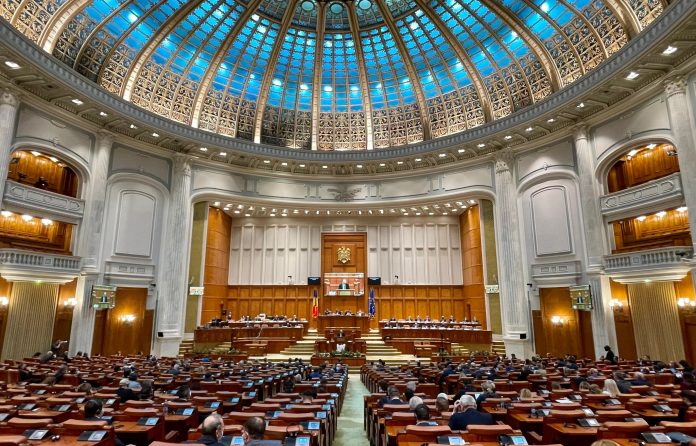
MPs on Wednesday adopted the re-examination, at the request of the President of Romania, of the Law amending and supplementing Government Emergency Ordinance No 31/2002 on the prohibition of organisations, symbols and acts of a fascist, Legionary, racist or xenophobic nature and the promotion of the cult of persons guilty of committing crimes of genocide, crimes against humanity and war crimes, as well as amending Law No 157/2018 on certain measures for preventing and combating antisemitism.
There were 173 votes in favour, 101 votes against and six abstentions.
The law initiated by the MP representing the Jewish community in Romania, Silviu Vexler, was adopted in its initial form, namely the version voted by the Senate, in accordance with the decision of the Constitutional Court.
On 21 June, the law was sent for promulgation. According to the provisions of Article 146 letter a) of the Romanian Constitution, on 18 June a challenge of unconstitutionality was submitted by MPs belonging to the parliamentary groups of the S.O.S. Romania Party, the Alliance for the Union of Romanians and the Party of Young People, as well as by non-affiliated MPs, and on 10 July the President of Romania, in turn, filed a challenge of unconstitutionality of the law.
The Constitutional Court, by Decision No 356/2025, dismissed as unfounded the objection of unconstitutionality lodged by the President of Romania.
On 3 December 2025, the President of Romania requested the re-examination of the law, arguing that the normative act sent for promulgation did not meet the requirements of predictability regarding the constituent elements of the offences it establishes and operated with insufficiently defined legal and criminal categories, which could lead to non-uniform and even abusive interpretations, the report mentions.
According to the draft, an organisation of a fascist, Legionary, racist or xenophobic nature is understood to mean any group formed of three or more persons which carries out its activity temporarily or permanently, for the purpose of promoting fascist, Legionary, racist or xenophobic ideas, concepts or doctrines, namely hatred and violence on ethnic, racial or religious grounds, the superiority of certain races and the inferiority of others, incitement to xenophobia, resorting to violence to change the constitutional order or democratic institutions, and chauvinism. This category may include organisations with or without legal personality, political parties and movements, associations and foundations, companies regulated by Company Law No 31/1990, republished, with subsequent amendments and additions, as well as any other legal persons that meet the stipulated requirements.
Fascist, Legionary, racist or xenophobic materials are understood as political propaganda documents such as manifestos, posters, advertising photographs, audio-visual commercials, statutes and programmes that convey the content of fascist, Legionary, racist or xenophobic doctrines, as previously defined.
The draft law also provides that a person guilty of committing crimes of genocide, crimes against humanity or war crimes is any individual definitively convicted by a Romanian or foreign court, or by any judgment recognised in Romania under the law, for one or more crimes of genocide, crimes against humanity or war crimes, if the offences for which they were convicted are defined in the statutes of international criminal tribunals, as well as a person in the statutory leadership of an organisation whose criminal nature has been established by the judgment of an international criminal court.
The distribution or public provision, in any manner, of fascist, Legionary, racist or xenophobic materials constitutes a criminal offence and is punishable by imprisonment from three months to three years or by a fine and the prohibition of certain rights. The act does not constitute a crime if committed outside a political or propaganda purpose, in the interest of art or science, research or education, for the debate of a matter of public interest, or for personal purposes between private individuals.
The act of publicly promoting the cult of persons guilty of committing crimes of genocide, crimes against humanity or war crimes, as well as publicly promoting fascist, Legionary, racist or xenophobic ideas, concepts or doctrines, is punishable by imprisonment from three months to three years or by a fine and the prohibition of certain rights.
The erection or maintenance in public places, except for museums, of statues, sculptural groups or commemorative plaques referring to persons guilty of committing crimes of genocide, crimes against humanity or war crimes, as well as persons who were part of the statutory leadership of an organisation whose criminal nature was established by the judgment of an international criminal court, is prohibited.
It is also prohibited to name streets, institutions or other public objectives after such persons.
The draft law was adopted by the Senate, with the Chamber of Deputies serving as the decision-making body. AGERPRES