
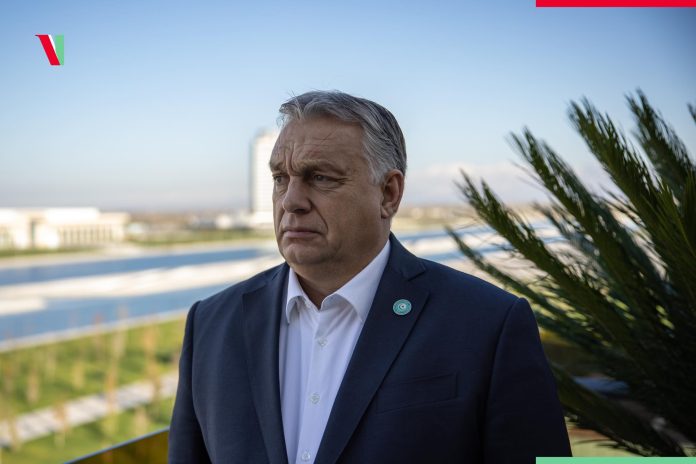
Former Prime Minister Viktor Orbán, leader of the opposition Fidesz party, said that Hungary was undergoing a process of ‘recolonisation’ and called for resistance against it during an appearance on commercial television channel HírTV on Sunday, according to MTI, as reported by Agerpres.
He also said that his ‘right-wing’ and ‘pro-national’ government had restored the country’s sovereignty between 2010 and 2026, stressing that, until 2010, 80% of Hungary’s strategic economic sectors had been under foreign control, particularly German control.
Orbán described the mission of right-wing national politics as a fight against colonisation, promising to continue this battle regardless of whether he was in opposition or in government. He promised to ‘liberate Hungary once again’.
He also criticised the Tisza government for lacking an independent foreign policy, claiming that decisions were dictated by the ‘colonial powers’ in Brussels. The government had abandoned Hungary’s ‘political safety net’ in its relationship with the United States, the country’s neutrality in the war between Russia and Ukraine, its agreements with China and its privileged cooperation with the Turkic world, he said.
‘We do not want war, migration, gender ideology, nor do we want to give up Christianity,’ Orbán said, stressing the need to ensure that ‘Hungary remains a Hungarian country’.
Orbán accused the current government of accepting a ‘Tisza-Brussels pact’, claiming that it would lead to the dismantling of Hungary’s sovereigntist forces opposing Brussels and, subsequently, to ‘handing Hungary’s economy over to Brussels’.
He said that the government would abide by ‘all of Brussels’ directives’ in exchange for remaining in power. Regarding EU funds, he argued that fighting for the country’s interests was not always a pleasant task, but that the current government refused to take it on.
The former prime minister attributed the economic difficulties to the absence of an appropriate economic policy, rather than a lack of funds, citing the energy crisis, the collapse of the agricultural sector, stagnation in the construction industry and protests by hauliers.
Referring to corruption allegations against his former government, Orbán insisted that they would prove unfounded, as the decisions taken in the past had been lawful and justified. He accused the Tisza party of misleading voters during the campaign, particularly over battery plants and a case of sexual abuse of minors linked to the youth detention centre.
Orbán advised the right-wing camp to focus on its own voters, whom he said were naturally discouraged after the electoral defeat. He acknowledged that, as a former prime minister, it was not his role to try to reach those who did not want to listen to him. ‘They have just voted us out so that they would no longer have to listen to me,’ he said.
Orbán urged representatives of the right to regroup over the next six months, engage with supporters and reorganise in order to remain relevant in Hungarian public life. ‘We are not there yet. We have a great deal of work ahead of us,’ the former prime minister remarked.
He described the Tisza government as ‘aggressive, radical and neo-communist’ and said that Bus Balazs – former deputy director of the National Cultural Fund (NKA), detained on suspicion of embezzlement – was a ‘political prisoner’.
Referring to the electoral defeat, Orbán said that ‘the disappearance of economic success during the 2024–2026 period’ had been his government’s main failure. ‘We could not prevent this,’ he said.
Orbán also claimed that the Tisza government was establishing an authoritarian regime and called for resistance.
He described the newly established National Office for Asset Recovery and Protection (NVVH) as an ‘AVH-type institution’ – a reference to Hungary’s infamous secret police during the communist period. According to Orbán, the MPs who established NVVH bore political responsibility for the actions of this body. He also said that ‘those who work at this institution, make decisions or take part in its procedures will not escape financial and legal liability once the rule of law has been restored’.
Orbán said that his party would monitor everyone working there, making their names, professional backgrounds and roles in extrajudicial proceedings public. ‘We will reveal who they are, who their parents are and what they do there,’ he said.
At the end of the programme, Orbán dismissed speculation about the future structure of the opposition as premature and counterproductive, given the uncertainties surrounding electoral legislation, the number of parties required and how candidates should organise themselves.
He said that the right’s only chance of securing victory or significant influence lay in unity. If fragmented by external forces or weakened by internal divisions, it had no chance, he said, adding that the same applied to left-wing parties.
Orbán described the right as intrinsically diverse, but united around three fundamental principles: a sovereign Hungary, the belief that a life without freedom is not worth living, and the value of the traditions and heritage left by one’s ancestors.
Commenting on the interview, Magyar wrote on Facebook on Sunday evening that ‘instead of making a sincere confession, Viktor Orbán dared to openly threaten the prosecutors, police officers and financial officials working at the National Office for Asset Recovery and Protection’.
‘My message to the mafia is: we will not back down,’ he said.
source – AGERPRES


